
With electric vehicle adoption continuing to grow across Canada, one question becomes increasingly urgent for households, condo boards, property managers, municipalities, and businesses: how do we make charging practical, reliable, and accessible for everyone?
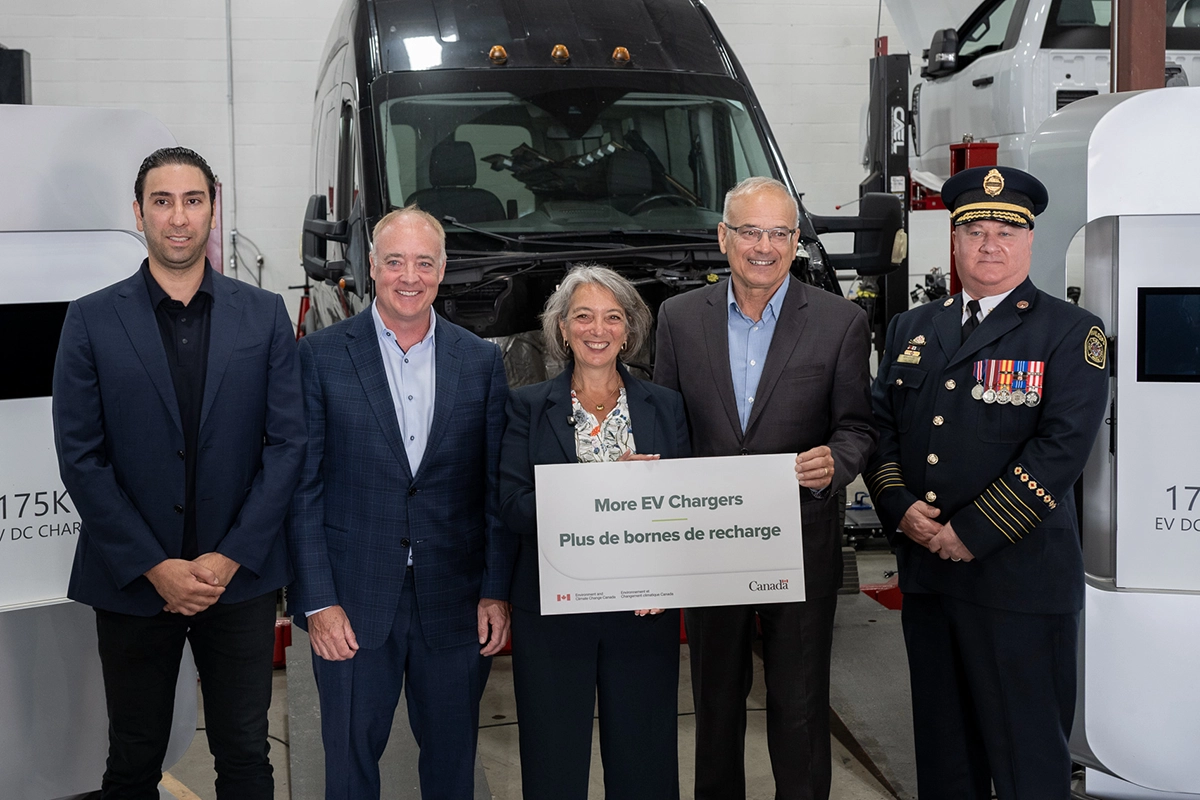
On July 30, 2026, Hypercharge joined a Government of Canada announcement in Burnaby, British Columbia, where the Honourable Julie Dabrusin, Minister of the Environment, Climate Change and Nature, announced $10.9 million for 22 electric vehicle infrastructure and education projects across Canada.
The funding includes almost $9 million for nine projects supporting the installation of nearly 400 chargers, along with approximately $2 million for 13 education and awareness projects designed to increase familiarity with electric vehicles, charging infrastructure, and EV ownership.
The event brought together Minister Dabrusin; Richard Stewart, Mayor of Coquitlam; Ken Uzeloc, Protective Services Director and Fire Chief for the City of Kamloops and a board member of the Canadian Association of Fire Chiefs; and David Bibby, President & CEO of Hypercharge Networks, speaking on behalf of the Canadian Charging Infrastructure Council.
Canada Is Investing in Infrastructure – and the Confidence to Use It
The announcement reflected a broader federal effort to make charging available wherever Canadians normally live, work, and travel. In British Columbia alone, there are now more than 8,900 public charging ports, an increase of 87% since 2023.
But the discussion made clear that physical infrastructure is only one part of the transition. Availability matters, and so does confidence. Drivers need practical information about where charging is available, how long charging takes, how vehicle range changes in different conditions, and whether an EV can meet their day-to-day transportation needs.
“These projects are part of a broader effort to make charging more convenient wherever Canadians are – at home, at work, or on the road – including rural and northern communities where options are still limited.”
The Honourable Julie Dabrusin
Minister of the Environment, Climate Change and Nature
The 13 education and awareness projects are intended to address those barriers directly. One initiative, led by Natural Indigenous Solutions Abound, will deliver EV test drives and charging demonstrations to Indigenous and rural communities across North, Central, and South Vancouver Island.
The federal government has invested more than $1.2 billion since 2016 to support the deployment of EV chargers and hydrogen refuelling stations across Canada. Minister Dabrusin connected that investment with affordability, cleaner air, Canadian jobs, and the country’s clean-electricity advantage.
“These investments will reduce emissions, improve air quality, make transportation more affordable, support good jobs, and make it easier for Canadians to choose an electric vehicle with confidence.”
The Honourable Julie Dabrusin
Minister of the Environment, Climate Change and Nature
Public Charging Is Becoming Core Municipal Infrastructure
The announcement also showed how national funding translates into practical local infrastructure.
The City of Coquitlam will receive $150,000 to install 30 Level 2 EV chargers. Mayor Richard Stewart said the chargers will be located at destinations residents already use, including civic facilities, recreation centres, libraries, and parks.
Coquitlam already has one of the highest EV-adoption rates in Metro Vancouver, and the city expects demand to continue rising as more residents choose lower-emission transportation. The new infrastructure is expected to nearly double the number of publicly accessible municipal chargers by spring 2027.
“Within a very short time, this investment will nearly double the number of publicly accessible chargers in Coquitlam by spring 2027.”
Richard Stewart
Mayor of Coquitlam
Stewart linked the project to Coquitlam’s climate and transportation planning, including its long-term objective of eliminating transportation-related greenhouse-gas emissions by 2050.
His broader point was that residents are already changing how they travel. The role of local government is to make lower-emission choices practical, convenient, and dependable – but municipalities cannot fund and deliver the transition alone.
“Our role as a municipality is to make those choices easier by building the infrastructure that gives people practical, reliable, zero-emission options. But no municipality can do this alone.”
Richard Stewart
Mayor of Coquitlam
Safe Deployment Must Grow Alongside the Charging Network
As charging infrastructure expands, safety planning must expand with it.
The Canadian Association of Fire Chiefs will receive $250,000 for a national project focused on EV-transition readiness for local governments and counties. The initiative will consolidate existing research, recognized standards, and operational expertise into a bilingual suite of resources for Canadian communities.
Planned deliverables include a national charging-station fire-guidance toolkit, planning and policy guidance, emergency-preparedness resources, builder and developer guidance, public-education materials, communications resources, a bilingual rapid-response learning program, and a permanent online resource centre.
Speaking on behalf of the association, Ken Uzeloc said fire chiefs support the shift toward electric transportation while emphasizing that new technologies must be introduced with fire, emergency-response, building-code, and life-safety considerations built in from the beginning.
“For the Canadian Association of Fire Chiefs, this funding marries the best of green innovation with its responsible introduction.”
Ken Uzeloc
Protective Services Director and Fire Chief, City of Kamloops
Uzeloc specifically highlighted the importance of lithium-ion battery awareness, emergency preparedness, and coordinated national guidance. The objective is not to slow innovation, but to make sure communities and first responders have the information required to support it safely.
Multi-Unit Residential Buildings Remain a Critical Access Gap
From our perspective, the next phase of EV adoption is not only about adding more public chargers. It is also about making charging possible where people live.
David Bibby joined the announcement as President & CEO of Hypercharge and spoke on behalf of the Canadian Charging Infrastructure Council, a national industry organization working to advance a comprehensive and economically sustainable EV-charging ecosystem.
Bibby began with the affordability case for electrification. Driving electric can materially reduce household transportation costs over the life of a vehicle, but those savings are not equally accessible to every Canadian.
“Driving an electric car can save a Canadian household between $23,000 and $32,000 over 10 years – and that’s real money back in people’s pockets.”
David Bibby
President & CEO, Hypercharge Networks
Nearly one in three Canadian families lives in a condominium, strata, or apartment. For residents without a private driveway, installing a charger can require coordination among owners, condo or strata boards, property managers, landlords, electricians, utilities, and other project partners.
The recurring questions are practical: Does the building have enough electrical capacity? What approvals are required? Who pays for the installation and electricity? How should access and costs be managed fairly? How can the system expand as more residents adopt EVs?
Hypercharge works with multi-unit residential communities, developers, property owners, and managers across Canada, and sees these challenges firsthand. Even when residents and building decision-makers want charging, uncertainty around process, cost, governance, and technical requirements can delay otherwise viable projects.
“If we’re serious about making the benefits of electric driving available to everyone, we have to solve that problem for the third of the country living in multi-unit buildings.”
David Bibby
President & CEO, Hypercharge Networks
Hypercharge’s Perspective: Clear Guidance Can Unlock More Projects
The Canadian Charging Infrastructure Council will receive $200,000 for a national project designed to accelerate the cost-effective and equitable deployment of EV-ready infrastructure in multi-unit residential buildings.
The project will support more informed decision-making and address common implementation barriers. For condo boards, strata councils, landlords, and property managers, clear guidance can help turn a resident request into a structured project plan – from initial assessment and electrical planning through approvals, cost allocation, installation, and long-term operation.
That matters because multi-unit residential charging cannot be treated as a one-size-fits-all installation. Every property has a different electrical system, ownership structure, parking arrangement, budget, and level of future demand.
A clear national resource can help building decision-makers compare approaches, ask better questions, and avoid redesigning the process from the beginning each time a resident requests a charger. It can also help projects account for future growth instead of solving only for the first vehicle.
For Hypercharge, this is where infrastructure, software, professional services, and education intersect. Reliable chargers are essential, but successful deployment also depends on the planning, stakeholder coordination, network management, and ongoing support behind them.
Partnership Is the Common Thread
Across the announcement, each speaker approached the transition from a different perspective: federal policy and investment, municipal infrastructure, emergency preparedness, and industry deployment.
The common thread was coordination.
The federal government can provide national programs and funding. Municipalities can identify community needs and public locations. Fire services can develop consistent safety guidance. Charging providers and industry organizations can bring practical experience from real-world installations.
That collaboration will be especially important as EV adoption grows across public charging, workplaces, fleets, and multi-unit residential buildings. It will also help ensure that infrastructure expands in a way that is reliable, safe, affordable, and easier for Canadians to understand and use.
The Bigger Takeaway: Charging Infrastructure Is Community Infrastructure
The announcement made one thing clear: the future of electric transportation is not just about vehicle availability. It is about charging access, education, safety, confidence, and smarter deployment of infrastructure.
For Hypercharge, that means continuing to deliver EV-charging solutions while helping properties and communities navigate the systems required to support them. The physical charger is only one part of the project. Long-term success depends on electrical planning, clear governance, equitable cost structures, reliable network operation, and coordination among public and private partners.
As adoption rises, the organizations and communities that succeed will be the ones that treat charging as essential building and community infrastructure – not as an afterthought.
Canada can make electric driving accessible to more people, but not by treating every installation as a one-off project.
It will take more chargers, clearer guidance, coordinated safety planning, stronger public-private partnerships, and a more equitable approach to where and how Canadians charge.