
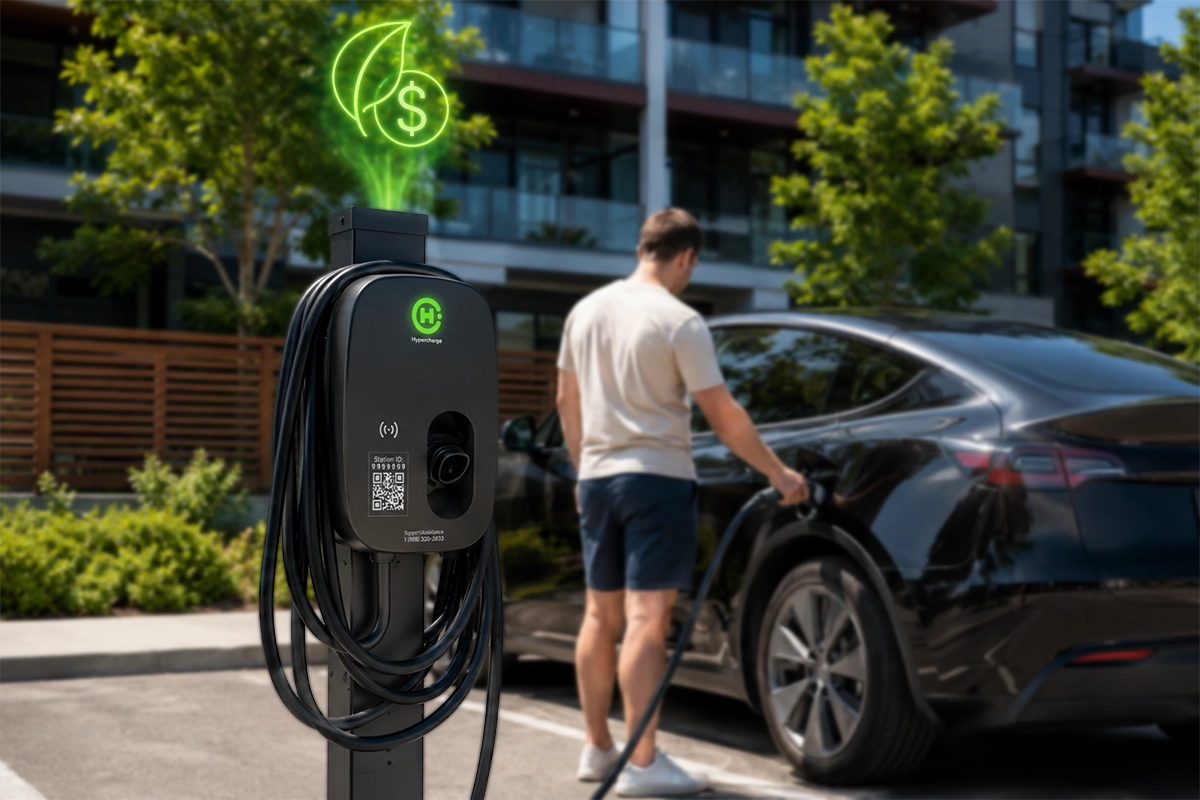
You may have heard that fossil fuel companies purchase carbon credits to offset their greenhouse gas emissions, but how does this system actually work? And can electric vehicle drivers and EV charging site managers get a piece of the action? Here’s a look at the system that rewards choosing clean energy, is accelerating EV adoption across Canada, and has been driving the rapid growth of Hypercharge’s public charging network.
What Are Carbon Credits?
Canada’s Clean Fuel Regulations (CFR) aim to reduce transportation-related carbon dioxide emissions and promote the adoption of cleaner technologies, including electric vehicles.
A core tool is a national credit market where participants can exchange carbon credits.
Each credit represents the avoided emissions from choosing clean energy over fossil fuels and is considered the equivalent of a one-tonne reduction in carbon dioxide.
Producers and importers of gasoline and diesel can purchase these credits to offset their carbon emissions and meet their annual reduction targets.
Participants in the carbon credits market can also create, accumulate, and sell carbon credits.
That’s where Hypercharge comes in. As a registered clean fuel supplier, Hypercharge generates credits whenever eligible charging takes place on our charging network.
Importantly, all proceeds from credit sales must be reinvested into clean‑energy infrastructure or programs that support EV adoption.
This requirement creates a virtuous cycle: the more Canadian drivers charge on the Hypercharge network, the more credits are generated, and the more Hypercharge can expand access to reliable clean energy.
For Hypercharge customers and partners, this means an increase in the number of charging stations in their communities and across the country. For investors, it means a growing stream of additional income and support for the long-term expansion of the Hypercharge network.
The Hypercharge Carbon Credit Program for BC Properties
In British Columbia, Hypercharge also participates in the province’s Low Carbon Fuel Standard (LCFS), the separate, BC-specific credit system behind our Carbon Credit Program. Businesses, condos, and apartment buildings can earn revenue based on a percentage of charging volume at Hypercharge stations located on their properties.
Once enrolled, properties begin earning credits automatically – no additional reporting or administrative work required – and receive rewards annually as either a cash payout or an equipment credit that can be redeemed for additional Hypercharge stations.
Hypercharge manages all tracking, buying, and selling of carbon credits on behalf of the property.
Hypercharge Pro Tip: BC’s LCFS system requires precise measurement of electricity supplied through each EV charging station. Real‑time tracking is available through Quantev™ Operations Suite, Hypercharge’s cloud‑based management platform.
Our Results
During the 2025 calendar year, Hypercharge received $1.74 million in proceeds from the sale of carbon credits generated by eligible charging activity – an increase of over 600% compared to the previous year.
This growth reflects the expanding Hypercharge public network and the strength of the CFR system: drivers, property owners, and fuel suppliers can participate in a clean energy market designed to continuously reinforce itself and its benefits for Canadian communities.
Talk to Hypercharge
Whether you manage EV charging at a commercial property, apartment or condo building, or public charging site, Hypercharge can help you understand how carbon credits can create additional value from your charging infrastructure.
Schedule a free EV charging consultation with a Hypercharge expert to learn more about carbon credit opportunities and the right charging strategy for your property.