
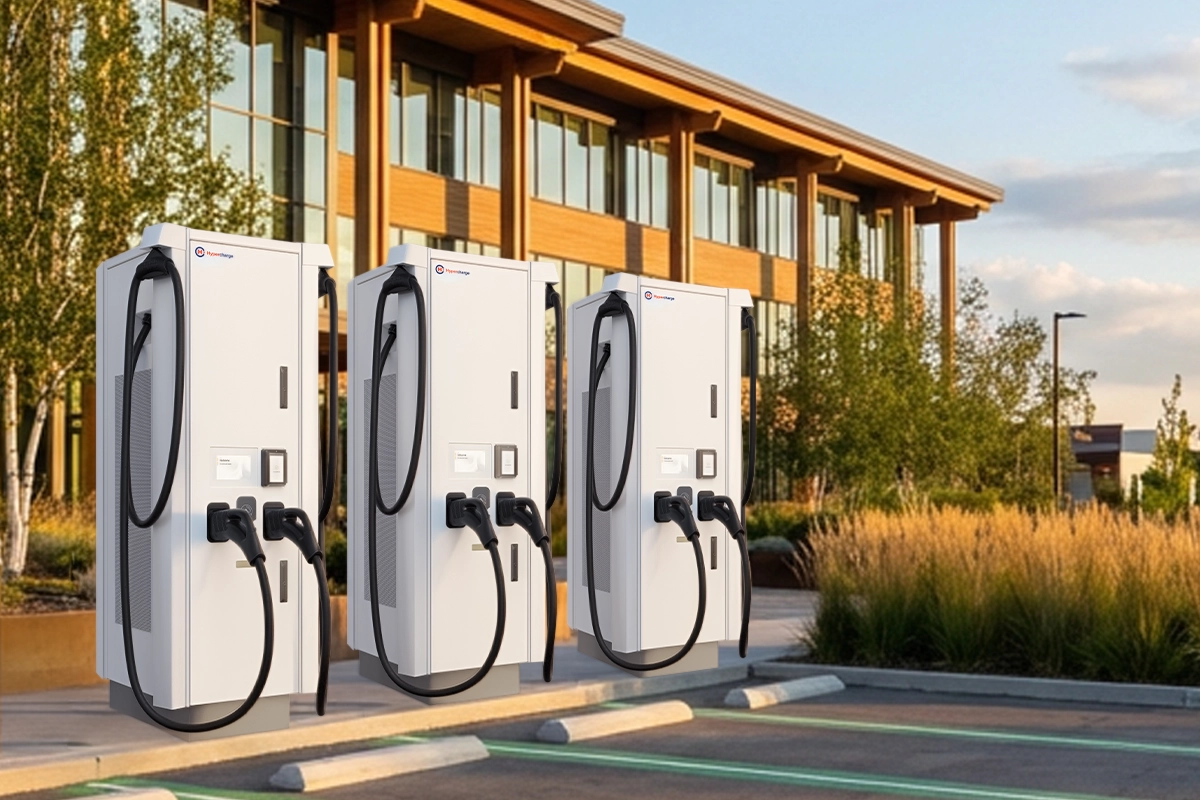
Starting January 1, 2026, the Ontario Energy Board is introducing a new Electric Vehicle Charging (EVC) rate that can cut a big chunk out of costs for qualifying public DC fast charging sites.
For many locations, this will be the policy change that finally makes DC fast charging pencil out on the spreadsheet.
This article breaks down what the EVC rate actually is, who qualifies, what it means for site hosts, and how to design your project so you are ready to apply.
What is the OEB EVC Rate?
The Electric Vehicle Charging (EVC) rate is a specialized delivery rate created by the Ontario Energy Board (OEB) for eligible EV charging stations with low load factors. Instead of paying full Retail Transmission Service Rates (RTSRs), participating sites pay only 17% of the standard RTSR charges.
A few key points:
- Effective date:EVC becomes available January 1, 2026, as part of utilities’ 2026 rate orders.
- What it touches:It reduces the RTSR portion of the delivery line items on your bill, which are the network and connection charges related to the high voltage grid. It does not change the energy commodity, distribution charges, or fixed monthly service fee.
- Why it exists:It is designed for public fast charging loads that spike to high kW when a vehicle plugs in, then sit close to zero when idle. Traditional General Service rates were built for flatter, building type loads and did not fit this pattern.
The EVC rate is part of the OEB’s broader Electric Vehicle Integration initiative to support cost effective charging infrastructure while keeping the grid reliable.
How much savings are we really talking about?
Hydro One’s published example for a 100 kW site helps illustrate the impact. Under its 2025 core delivery charges, a General Service customer with a 100 kW monthly peak would see transmission related delivery charges drop by roughly $480 per month under EVC, simply because RTSR line items are multiplied by 0.17 instead of 1.0.
That works out to about $4.80 in savings per kW of monthly peak demand. So:
- At 100 kW, savings are around $480 per month.
- At 300 kW, savings are roughly $1,400 per month.
- At 500 kW, savings push toward $2,400 per month.
Those dollars can improve the business case for new sites, fund lower pricing for drivers, or be split between both strategies.
Want to explore what the EVC rate could mean for your Ontario location? Connect with the Hypercharge team and we will help you run the numbers.
Who qualifies for the EVC rate?
The OEB’s EVC Frequently Asked Questions and Final Report outline the eligibility criteria. To participate, an EV charging station in Ontario must meet all of the following conditions.
Technical and usage criteria
- The site has at least one DC fast charger (DCFC).
- At least 90% of the site’s total monthly peak demand is attributable to EV charging.
- The site’s monthly peak demand is between 50 kW and 4,999 kW, which aligns with the General Service band.
- The 12-month average load factor is 20% or less. In other words, the station is used less than 20% of the time on average and is still ramping up utilization.
Customer and system criteria
- The site must not primarily serve commercial or public sector EV fleets. It is intended for public charging, not dedicated fleet depots.
- Any distributed energy resource (DER) behind the account’s meter, such as solar or battery storage, cannot exceed the station’s annual peak demand.
What this means for Hypercharge sites with DC fast chargers
For sites in Ontario, the new EVC rate is a powerful lever:
- Stronger project economics in early years while utilization is still growing.
- More flexibility on pricing, whether you prioritize driver affordability, margin, or a balance.
- New models for workplaces, where DCFC can be both an employee benefit and a public charging asset that qualifies for EVC.
- Clearer data expectations, where metering and monitoring play a strategic role, not just an operational one.
Talk to Hypercharge
Hypercharge partners with municipalities, workplaces, developers, and community leaders across Ontario to plan and deploy public EV charging that performs in the real world. Our team helps you evaluate how the new Ontario EVC rate could strengthen your project, model demand profiles, design metering and submetering that align with eligibility rules, and use live data to track load factor and long term site performance.
Schedule a free EV charging consultation with one of our experts today to explore options for your property or organization, from early site planning and utility engagement through to installation, launch, and ongoing monitoring.