
A successful electric vehicle charging session is a simple one, completed in just a few easy steps. Achieving that simplicity, however, takes a complex interplay of hardware, software, and communication systems that work together seamlessly to create a frictionless experience.
For new EV and charging station owners, learning about the relationships between of all these components can feel overwhelming.
In this primer, we break down two essential building blocks: the physical connections between vehicles and charging stations and the invisible communication links that bring the entire ecosystem together.
Charging Connectors
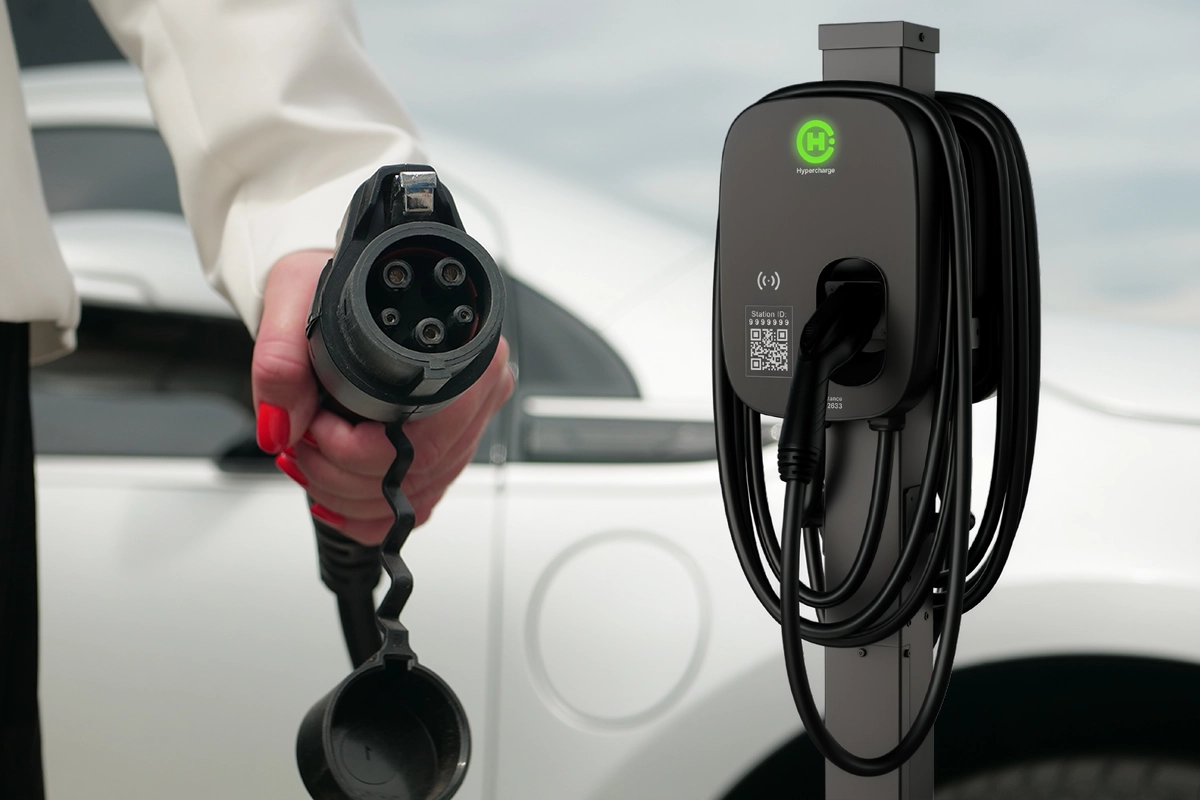
Charging connectors are the physical link between a vehicle’s charge port and the plug on a charging station. The type of connector determines whether an EV is compatible with a particular charger, the charging level, or speed of charging, that can be achieved, and which charging networks the vehicle can access.
In North America, the standard connector for Level 2 AC charging is the SAE J1772, or “J plug.” This connector is the most commonly used type across EVs and is the default interface for most AC charging equipment.
For DC fast charging, many vehicles use a Combined Charging System (CCS) connector, also known as the SAE Combo Connector. CCS contains both SAE J1772 AC pins and DC fast charging pins, for an all-in-one connector that works across charging levels.
The CHAdeMO (“charge de move” or “charge to move”) connector is another DC charging connector previously used but now being phased out.
Most North American vehicle manufacturers support these connections, with one big exception: Tesla vehicles use a North American Charging Standard (NACS) connector. NACS connectors have a compact design that supports all levels of charging and can be paired with adapters to allow Tesla drivers to access other charging networks. Adapters can also be used to connect non-Tesla vehicles to the Tesla charging network.
In 2022, NACS became available to all vehicle manufacturers and has been increasingly used for non-Tesla models. To accommodate the expansion of NACS vehicles across North America, Hypercharge now offers NACS connectors for Level 2 and DC fast charging stations.
Plugging In Confidently with Hypercharge
Mechanical problems with plugs are a common source of charging headaches, whether caused by user error, damaged hardware, or a worn-out hardware.
When the connector doesn’t firmly attach to the vehicle’s port, a charging session might fail to start or cut off mid-session.
Hypercharge charging stations get in front of plug problems with durable hardware, clear guidance, real-time monitoring, and 24/7 support for drivers and station managers.
Hypercharge Pro Tip: Need to make a change? For most Level 2 charging stations, Hypercharge can swap a SAE J1772 connector for NACS upon request.
Communication Protocols
EV charging protocols are the systems that allow electric vehicles, charging stations, and charging networks to talk to each other.
They operate through a digital “language” that permit the exchange of data for essential functions, such as accessing a charging network, broadcasting the availability of a charging station, and processing usage data and payments.
One of the most important protocols is the Open Charge Point Protocol (OCPP). This free-to-use communication system connects EV charging stations to central management systems—the backend software that controls and monitors charging and related functions. It has become the most widely adopted communication standard globally.
Hypercharge’s OCPP Advantage
All of Hypercharge’s charging stations are OCPP-compliant. This means Hypercharge hardware can communicate with any OCPP-compliant EV charging network and software, giving station owners the freedom to choose the particular ecosystem that works best for them.
Hypercharge Pro Tip: Our OCPP-compliant EV charging network makes Hypercharge charging stations discoverable through popular charging apps and enables payments through secure transactions.
Talk to Hypercharge
Plugs and protocols play a big role in how well EV charging performs. Hypercharge helps properties navigate charging hardware, connector options, and network connectivity to create a better experience for both drivers and site owners.
Schedule a free EV charging consultation with one of our experts to explore the right charging setup for your property and plan for a system that supports smooth, dependable charging as EV adoption grows.