
When electric vehicle drivers estimate their charging needs, they often focus on an EV’s driving range, the distance it can travel on a full battery.
That number is useful, but real-world performance depends on several factors, including driving patterns, environmental conditions, and even user psychology.
Below, we look at all of these elements to help you understand and plan for your own charging needs.
Hypercharge Pro Tip: According to the International Energy Agency, the current average EV driving range is 380 kilometers (236 miles).
Typical Mileage
Start with mileage. Use the vehicle’s trip counter or map your regular routes to track the number of kilometres or miles you travel on both a typical weekday and weekend, multiplying these figures to find out how much distance you cover per week. Be sure to include routine commutes, errands, and activities, as well as regular weekend jaunts.
Adjust Your Driving Range Expectations
When comparing your mileage to your vehicle’s stated range, remember that how and where you drive can have significant impact on how far you can go before recharging.
Speed
One of the biggest impacts on range is speed. When you hit the highway, the wind drag at higher speeds makes the vehicle work harder, increasing the energy demand and decreasing range.
Acceleration
The amount of energy required to get up to speed spikes when an EV accelerates quickly. If you have a lead foot, expect to see some impact on driving range.
Cargo
Do you regularly hitch your vehicle to a towing trailer, strap a kayak to the roof, or carry a full load of passengers? Extra weight takes more energy to move and items attached to the exterior increase wind drag.
Temperature
Extreme temperatures can cut down driving range, with interior heaters and air conditioning spiking energy demand by as much as 20 per cent and 18 per cent, respectively.
Hypercharge Pro Tip: Check out these tips for smart habits that maximize range.
Identify Your Public Charging Type
How much you rely on public charging can be as much a matter of psychology as your driving patterns.
A 2025 study identified five types of public charging users based on behaviour: regular, range-anxious, functional, infrequent, and non-users. Understanding which group you fall into can help you create a confidence-boosting charging plan.
Regular users charge at home as often as others but tend to stop when the battery reaches 60 to 80 per cent full. Creatures of routine, they’ll choose familiar public chargers over the closest ones.
Range-anxious users top-up whenever possible, usually at the nearest public charger. They opt for a full charge if they can and have a high tolerance for wait times.
Functional users are driven by need alone. They rely on public charging mainly when their battery dips below 20 percent.
Infrequent and non-users depend mostly or entirely on home or workplace charging.
Assess Your Charging Needs
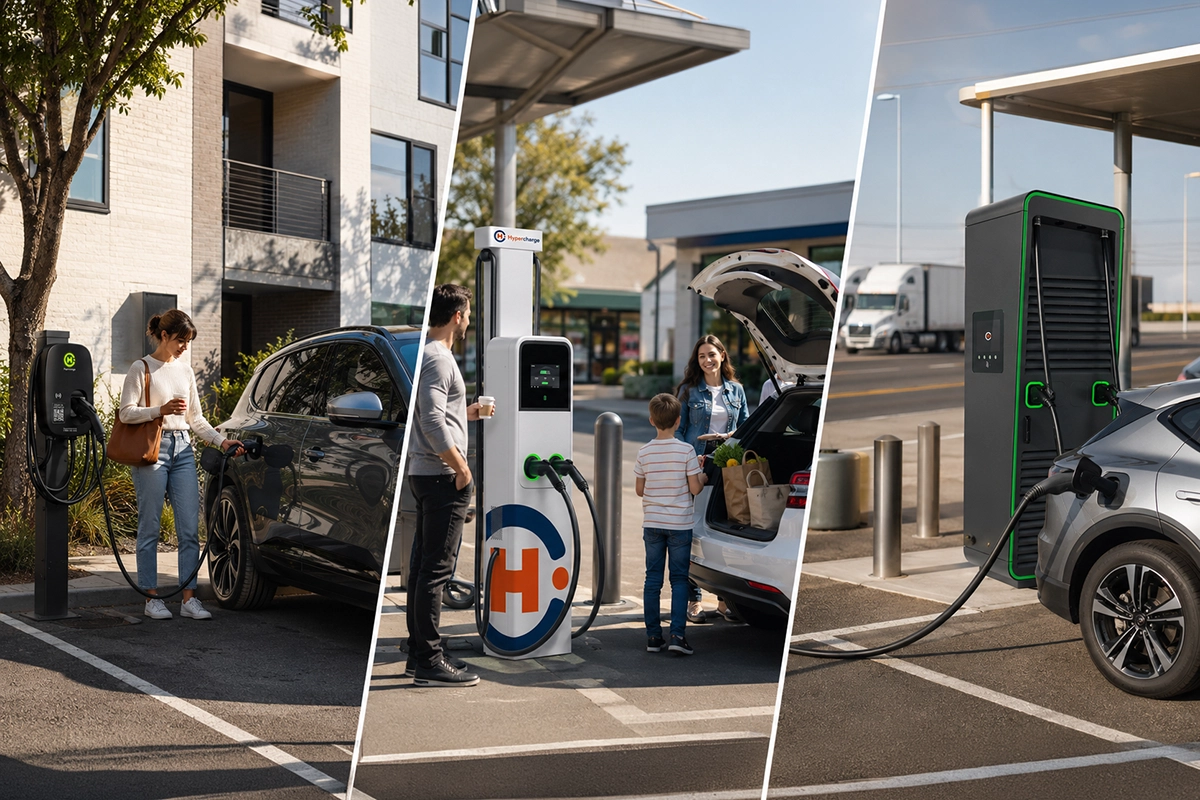
What sort of charging setup do you need – routine, flexible, or robust? We’ve sorted EV charger users into our own three categories based on driving and charging behaviours, with recommendations for how best to ensure your charging needs are met.
Routine Home or Workplace Charging
- Driving patterns: Urban commuting, weekend puttering, nearby side quests
- Mileage: 50 kilometres (31 miles) or less daily
- Speed: Mostly city speeds
- Public charging: Occasional use, as needed
If you have a relatively small roaming range and don’t panic when your battery level drops below 50%, access to a Level 2 charger at home or work will easily keep up with your charging needs, even on the coldest winter days.
It can add about 50 kilometres of range in an hour and fully recharge your battery overnight or during a workday.
Flexible, On-the-Go Charging Solutions
- Driving patterns: Suburban commuting, shuttling passengers and cargo, weekend day trips
- Mileage: 100 kilometres (62 miles) daily, with occasional spikes on weekends
- Speed: Mix of city and highways speeds
- Public charging: 1–2 sessions weekly
If your vehicle plays several roles in your life or if you’re a range-anxious user, your charging needs may be greater or shift from week to week. In addition to home or workplace charging, you require convenient Level 2 public chargers and the occasional DC fast charging session for extra peace of mind.
Hypercharge’s Driver Mobile App can help you locate reliable chargers for your regular routes and special outings.
Robust EV Charging for Road Warriors
- Driving patterns: Regular day trips, business travel, long road trips
- Mileage: Frequently 300+ kilometres (93 miles) or more
- Speed: Heavy highways use
- Public charging needs: Quick top-ups at rest stops or when battery runs low
If you travel long distances, spend a lot of time on highways, or often let your battery drop below 20%, you may need a more robust charging setup. Level 2 chargers can cover routine charging and small top-ups on the road, but long-range travel and low battery levels may demand DC fast charging.
These high-powered stations offer the ultra-fast full charges that are essential when charging opportunities are spread farther apart.
Hypercharge Pro Tip: EVs that have a lower driving range can be suitable for longer distances if the vehicle has a powerful charging capacity – the maximum rate at which its onboard charger can take in energy – and there are regular charging opportunities enroute.
Talk to Hypercharge
Every site has different charging needs. Whether you’re planning EV charging for a multifamily property, workplace, fleet, or public location, Hypercharge can help you assess demand, choose the right charging solution, and plan for reliable long-term operation.
Schedule a free EV charging consultation with Hypercharge to find the right EV charging setup for your property.